

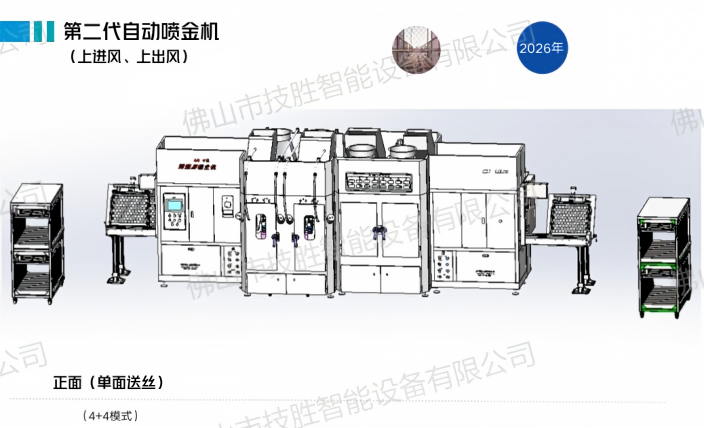
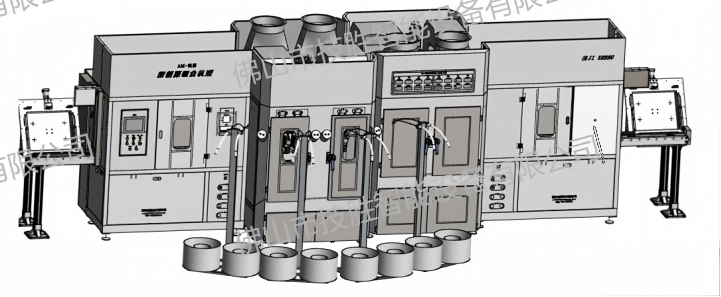
Equipment Structure Description
(1) The equipment cabinet is welded with square tubes and cold-rolled steel plates. After rust removal treatment, thermal spraying is applied on the surface. The cabinet features excellent tightness and is equipped with three layers of imported sound insulation materials for noise reduction.
(2) Arranged from left to right, the machine is equipped with two metallizing chambers: Chamber A for Guns 1–4 on the front side and Chamber B for Guns 5–8 on the rear side, forming a 4+4 metallizing configuration. Gun scanning is driven by a servo system, and the spacing of each gun can be adjusted independently.
(3) The carrier frame conveying system is elaborately designed and driven by a frequency converter, ensuring stable operation and long service life.
(4) Gun scanning adopts servo drive. The spacing of each gun can be independently adjusted, and the moving speed of guns can be automatically modified via digital input on the touch screen. The guns are equipped with an automatic dust blowing function. Parameters such as carrier frame moving speed are adjustable.
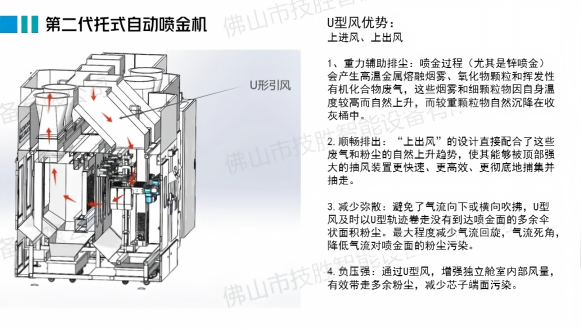
(5) Top exhaust dust collection system:
The top exhaust design delivers high dust removal efficiency. Adopting U-type air flow, it improves air volume inside individual chambers, effectively removing excess dust and minimizing contamination on capacitor winding end faces.
Uniform air flow inside metallizing chambers brings remarkable energy saving. It reduces required dust collector capacity and lowers customer investment cost.
The machine features attractive appearance with compact and reasonable layout.
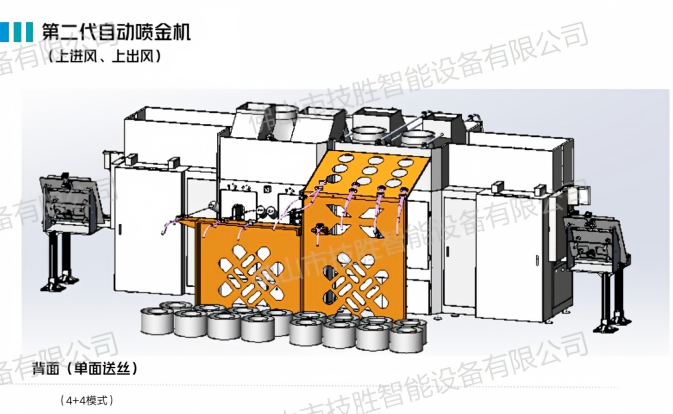
Working Principle of Equipment
This equipment adopts two electrified metallizing wires. Short-circuit current is generated when the wires collide during feeding, creating high temperature to rapidly melt the metal wires. The molten metal is blown onto components by high-speed compressed air to form a metallized layer.
The 8-gun double-side independent metallizing chambers adopt a left-in and right-out conveying mode. Core fixtures travel at a constant speed on the conveying line. Operators manually load cores in the feeding area, then stand the fixtures upright and push them onto the conveyor belt.
When capacitor windings enter Chamber A, vertically moving spray guns complete front-side metallizing with the first four guns. As the metallizing fixtures move to Chamber B, the rear-side metallizing is finished in one pass to the required thickness in the same working mode. After full metallizing is completed, the conveyor automatically transports the core frames to the unloading area for discharging
Manual Fixture Loading → Conveyor Feeding → Front Side Metallizing (Gun 1-4) → Automatic Dust Blowing → Rear Side Metallizing (Gun 5-8) → Conveying Transition → Manual Fixture Unloading
Advantages of Timing Belt
Higher efficiency than chain drive. Carrier frames operate with zero clearance between each other to improve production efficiency.
Chainless structure reduces failure rates of chain components and cuts maintenance & servicing costs.
Top-in and top-out air ventilation delivers outstanding dust removal performance. It avoids eddy current of dust, which would otherwise cause cross-contamination on capacitor winding end faces.
