

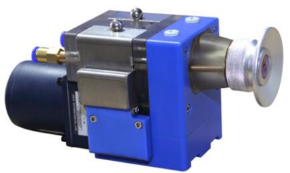
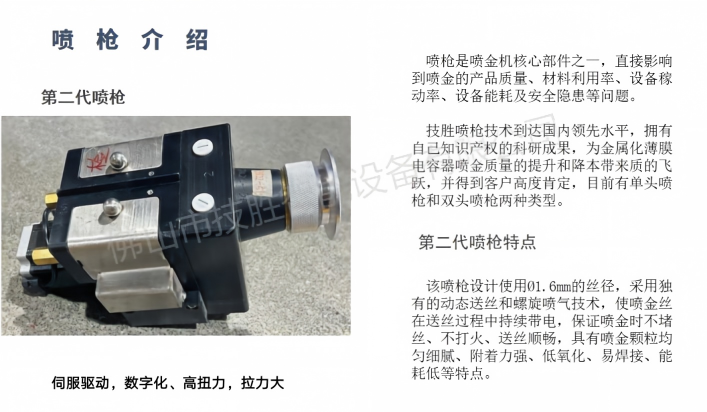
The spray guns equipped on this metallizing machine adopt technology originating from Germany. We have carried out independent innovations after drawing on strengths from multiple solutions and developed proprietary patented technology.
The spray guns deliver uniform and fine metallizing effect with high jet concentration, featuring low oxidation, no wire jamming and no wire bursting. Boasting attractive appearance and outstanding durability, they have been widely used by domestic and international capacitor manufacturers, including Guangdong Fengming, Anhui Tongfeng, Zhejiang Wufeng, Sungho (South Korea), Fudi Battery, Yingfeng Electronics, Xiamen Faratronic and other enterprises.
Designed for metallizing wire with a diameter of Ø1.6 mm, the spray gun adopts exclusive dynamic wire feeding and spiral air injection technology. The metallizing wire remains continuously electrified during feeding, ensuring smooth wire feeding without wire blockage or abnormal sparking. It offers advantages such as uniform and fine metallized particles, strong adhesion, low oxidation, good solderability and low energy consumption.
Gun scanning is driven by servo systems, and the spacing of each spray gun can be adjusted independently. The moving speed of spray guns can be automatically adjusted through digital input on the touch screen. Each spray gun is equipped with an automatic dust blowing function.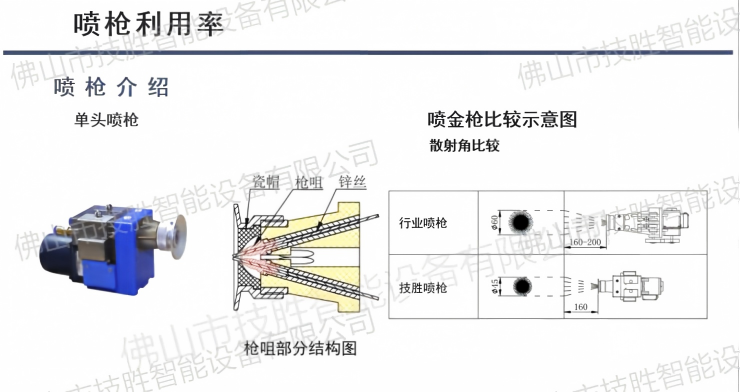
Advantages of Spray Guns
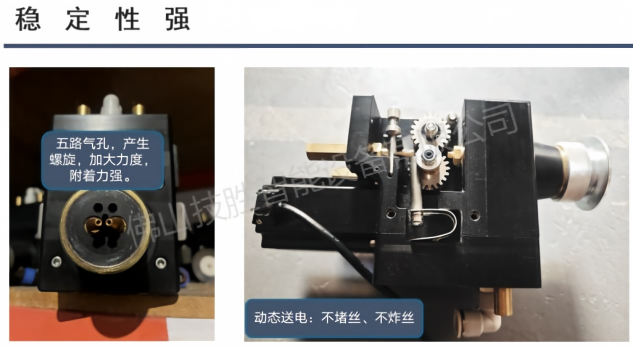
Dynamic power supply ensures stable metallizing current Current is transmitted to the wire instead of the conduit throughout the process, guaranteeing stable metallizing current. It is uniquely capable of controlling metallizing current within ±1A in the industry, securing consistent product quality.
Smaller spraying diameter compared with other spray gun brands in the industry. The 45mm spraying diameter enables more precise spraying coverage on component end faces and reduces the waste of zinc wire.
Five-channel spiral air injection The airflow enables firm and precise adhesion onto component end faces, improving the bonding force and penetration capacity of the first metallized layer.
